
Interviewed by Kimberly Dennis, MD, CEDS
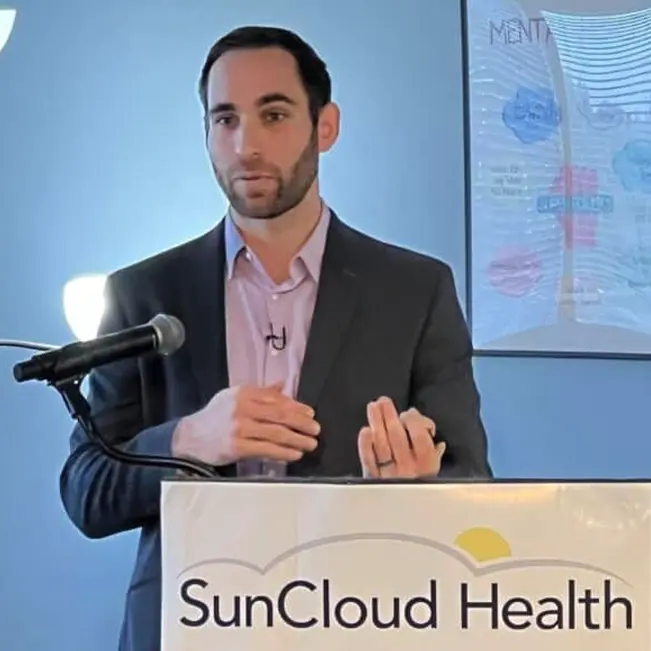
Joshua Siegel, MD, PhD
Psychiatrist at Washington University School of Medicine in St. Louis, Neuroscientist, Neuropsychopharmacologist
1. How big of a health problem are depression, addiction, and eating disorders, diseases that are chronic & relapsing without cures?
Depression, addiction, and eating disorders: These are major health problems, affecting millions of people worldwide. Depression alone affects more than 264 million people, addiction (including alcohol, opioids, and other substances) affects over 20 million adults in the U.S. alone, and eating disorders impact about 30 million people in the U.S. over their lifetime. If I’m not mistaken, rates of all 3 have increased in the past decade. All of these disorders are associated with significant morbidity, mortality, and a considerable economic burden on healthcare systems worldwide.
2. The success of ketamine, immediate in some patients, in treating their depression and changing their minds about suicide has helped to stimulate psychedelics getting the interest of research psychiatrists like yourself and top research medical institutions across the USA like WUSTL or Harvard or Stanford or Yale. How did you get into studying psychedelics in Anorexia, Depression, and Addictions?
Getting into psychedelic research: I was involved in a ketamine neuroimaging clinical trial with the Healthy Mind Lab at Washington University Psychiatry, which has been doing ketamine research for decades. Seeing promising results from psychedelics studies suggesting rapid and lasting relief for depression (perhaps even greater than ketamine) sparked my interest. The fundamental driving question was: what is the meaning of the “neurotrophic” effects of ketamine and psychedelics that we see in animal models at a systems neuroscience level, and how is that affecting the human brain, mood, and cognition? Grants from the Taylor Family Institute Fund for Innovative Psychiatric Research, the McDonnell Center for Systems Neuroscience allowed Dr. Ginger Nicol and I to start the WU Program in Psychedelics Research and the first human psychedelics study.
3. Psilocybin has been heralded as the subsequent new treatment for depression that works. Does it work? How do you know? What is necessary for psilocybin to reverse depression ratings at Day 2 and for that to persist for week 12 after a single dose of 25 mg psilocybin? How can someone using at home find a psychedelic therapist?
Psilocybin as a treatment for depression: These are some of the central questions that I will explore in my talk. Early trials have shown that a single high dose of psilocybin, given in a controlled setting and accompanied by psychotherapy, can lead to rapid and persisting reductions in depression scores. Like all treatments, it won’t work for everyone. There are methodological challenges with these trials and limitations to their generalizability. And there are risks. The exact mechanisms are still being researched, but theories include neuroplasticity, changes in brain connectivity, and experiences of transcendent or mystical states that can lead to shifts in perspective and behavior.
Psilocybin remains a DEA Schedule 1 drug at this point, which makes it difficult to find psychedelic therapists. Multidisciplinary Association for Psychedelic Studies does provide a list of practitioners for psychedelic integration: https://integration.maps.org/
4. While most psychiatric treatment is only effective weeks after initiation and rarely cures the disease, psychedelics appear quite different. If so, Why? How far out do the outcome studies go?
The neurotrophic hypothesis: The leading scientific consensus is that there is some critical importance of the neurotrophic effects in answering your question. Traditional antidepressants like SSRIs increase the amount of serotonin in the brain. However, these drugs don’t instantly alleviate depressive symptoms despite the immediate increase in serotonin availability. This led researchers to investigate other downstream effects of SSRIs, leading to the neurotrophic hypothesis (Duman & Monteggia, 2006).
According to this hypothesis, chronic stress or depression results in the atrophy of certain parts of the brain, especially the hippocampus, an area crucial for memory and emotional processing. Antidepressants like SSRIs stimulate the production of brain-derived neurotrophic factor (BDNF), a protein that supports the growth and differentiation of new neurons and synapses. This neurogenesis takes several weeks, which could explain the lag period before patients begin to feel the benefits of treatment.
More recently, ketamine and psilocybin have been shown to produce a cascade of events that results in rapid release of BDNF and rapid growth of neurites and synapses. This could explain why the effects of ketamine and psilocybin are seen much faster, within hours, as this process is quicker than the new neuron growth stimulated by SSRIs.
It should be noted, however, that while this explanation is backed by some research, the understanding of antidepressant mechanisms is still not complete, and these drugs likely work through a combination of various mechanisms, many of which we’re still learning about.
In the largest human clinical trial to date, adults with treatment-resistant depression received a single dose of a synthetic psilocybin at a dose of 25 mg, 10 mg, or 1 mg (control). The 25mg group showed an antidepressant response compared to the 1mg control which remained significant for 6 weeks. Some open-label studies have looked at longer endpoints, but I don’t think they should be given much weight.
5. How do you understand the ketamine and psilocybin literature for Alcohol Use Disorders? Is a cure possible? How far out does the outcome data go? What does your brain imaging work say?
Ketamine and Psychedelics for Alcohol Use Disorders: Early research indicates the potential benefits of ketamine, psilocybin, and possibly other psychedelics for alcohol use disorders. I fundamentally reject the idea that any single treatment is a ‘cure’ for addiction. But anything that might facilitate quitting and abstinence seems worth seriously considering.
You and your group have done studies of psilocybin in another incurable, chronic, and relapsing disease with excessive mortality—eating disorders. Do psychedelics offer any hope?
Psychedelics and eating disorders: I have not been involved in any research giving psilocybin to individuals with eating disorders. But studies are ongoing (including one sponsored by COMPASS with sites in Baltimore, New York, San Diego, London, and Dublin – based on data from clinicaltrials.gov).
6. What are the most significant risks at this point in the use of psychedelics with patients who have depression, PTSD, or eating disorders?
Risks of psychedelics: In my opinion, the most significant risks associated with psychedelic therapy include increased suicidal thoughts/behavior (which have been observed in a small minority of patients in published clinical trials to date) and the potential for misuse or abuse in inadequately controlled settings. The FDA has recently shared a preliminary draft of guidelines for how to conduct psychedelic clinical trials which may help to mitigate the latter risk.
7. We are following the progression of the clinical trials, and FDA comments on placebo and trial design with great interest. Do you agree that MDMA therapy will be approved for PTSD next year? How does that work? What is necessary for it to be successful?
MDMA therapy for PTSD: There is optimism about the potential for MDMA-assisted therapy for PTSD, and yes, it’s possible we may see approval for this therapy in the near future. But the protocol in the MAPS phase 3 studies was extremely intensive and I think that there will be major challenges to making such a protocol widely accessible to patients, particularly those with less financial means.
8. Where should you go to get training as a psychedelic therapist? What do you think about the field trip model office for psychedelic delivery? Is it like the Roland Griffith model at Hopkins?
Training as a psychedelic therapist: Organizations such as MAPS and the California Institute of Integral Studies (CIIS) offer training programs for therapists interested in psychedelic-assisted therapies. Any FDA approval or decriminalization at the state or federal level is likely to include criteria for certification for practitioners and training. As for the Field Trip model, it’s a step in a promising direction, making psychedelic therapies more accessible. The Roland Griffiths model at Hopkins emphasizes rigorous scientific investigation and medical safety, which should remain paramount as these therapies become more widespread.
Explaining SunCloud’s Integrated Model Why is an integrated treatment model essential to successfully treating patients?
Dr. Kim Dennis, Co-Founder and Medical Director at SunCloud Health, discusses the vital role the integrated model (that she is pioneering at SunCloud Health) plays in the success of treating patients with co-occurring disorders and underlying trauma. How does SunCloud create an authentic culture of patient support?